Showing posts with label Family History. Show all posts

Wednesday, November 30, 2016

Don't Give Up The Ship


Captain James Lawrence
These words, uttered by my 4th great grandfather, Captain James Lawrence, as he was carried below deck, mortally wounded during the battle between his ship, the USS Chesapeake and the HMS Shannon during the War of 1812, became a popular naval battle cry after his friend, Commodore Oliver Hazard Perry, used them on his personal battle flag.    

Born in 1781, James entered  the navy on the 4th of September, 1798, when he was not yet seventeen years of age. He became a lieutenant in 1802, a Master Commandant in November, 1810, and a Captain in March 1813. 


"His mother died when he was still an infant, and he was left to the care of his sisters, to whom he seems to have been greatly attached, especially to his half-sister Elizabeth (Mrs. Michael Kearney, aka Madame Scribblerus), and it is doubtless to their influence Lawrence owed the gentleness of his disposition, which was one of his distinguishing characteristics."+  
'My brave, brave Jim's a sailor Jack. Upon the treacherous sea — A sailor who loves poetry. All taught to him by me.' ~Madame Scribblerus+ 

James' rise to celebrity began in early 1813. During a cruise of one hundred and forty-five days he captured one ship, two brigs, one schooner and one man-of-war. "His fame passed far beyond description by empty phrases and colorless adjectives, and he became one of the heroes of the day".+ When he died, he had three funerals: one at Halifax, Canada, one at Salem, Massachusetts, and the last at New York, New York. "The whole city of New York was in mourning, the bells were tolled, minute guns fired and the vessels in the harbor half-masted their flags. Not since the funeral of Alexander Hamilton had there been such demonstration of public grief."+ 

Julia Montaudevert Lawrence
 "Julia Montaudevert, a lovely girl of nineteen, the daughter of a New York merchant, gave her hand at the altar of Trinity (June 28, 1809) to Lieutenant Lawrence, then twenty-seven, and reputed the handsomest officer in the American navy, as he certainly was one of the bravest of any navy. She lived opposite the Bowling Green, near by, then the most elegant, quiet, and fashionable quarter of New York.” *

When appointed to captain the Chesapeake, James unsuccessfully appealed to his superiors, "NEW YORK, May 10, 1813. SIR:— I was yesterday honored by the receipt of your letter of the 6th inst., revoking your order of the 4th and appointing me to the command of the Frigate "Chesapeake...When I requested permission to go out again in the "Hornet" I conceived that I could with propriety leave my family, but have since found that Mrs. Lawrence's health is so delicate and her situation at this time so very critical that I am induced to request your permission to remain until the "Constitution" is ready"...+

In fact, Julia was pregnant with their second child, and little daughter Mary had turned three on May 5. "Her health was so delicate at the time of her husband's death that the event was concealed from her, though with great precaution and difficulty. Lawrence died in June, and his wife knew it not until September. Meantime, having given birth to a son (who lived but fifteen months), she constantly inquired as to the whereabouts and welfare of her husband, wondering why he did not write, and asked constantly to have the news read to her.”# 

On the fateful day of his death, June 5, 1813, James and Julia were just three weeks shy of their fourth wedding anniversary and James had been away on duty most of that time.

Although James is famous as the author of the words, "Don't Give Up the Ship", Julia was the one who lived them. She gave birth to their son, James Montaudevert Lawrence on July 8, 1813, which must have brought her great solace. Yet, once more, she was dealt a cruel blow when little James died on September 19, 1814. 

"Her affections, thus rudely despoiled, were centered on her daughter, the pride and comfort of her bereaved life."#


Mary Neill Lawrence Griffin
That daughter, Mary Neill, grew to adulthood, and married William Preston Griffin, also a Navy Lieutenant, on May 7, 1838 at the same place her parents had married 28 years previously, Trinity Church in New York. Just five years later, tragedy struck the family again, when Mary died on September  3, 1843, just days after giving birth to her only child, a daughter, Mary Lawrence Griffin. "...spent the summer of 1843 in a villa outside the walls of Florence. It belonged to the Marquis d'Elci. In the end of the summer a dear friend of my mother's died there, in the apartment adjoining mine. She was the daughter of Captain James Lawrence...We met them on the way to ltaly, and persuaded them to go with us to Florence for the summer. She died in child-bed at the villa September 3. It was like the falling of a sudden night about our path."** 


Lt. William Preston Griffin
Evidently, Julia accompanied her daughter and son-in-law to Europe. But, she became ill, "a milder climate was recommended, and in a few weeks Mrs. Lawrence returned childless to the United States. It was while passing the Summer of that year at Newport that she determined to make it her home. She occupied a small but eligibly located cottage...many of the old residents remember her then, with her beautiful grandchild and handsome Italian nurse, a mourning but dignified and urbane lady, who soon endeared herself to the people among whom she thenceforth lived."#


Mary Lawrence Griffin 
Mary's father, Lt. Griffin, devastated by his loss, had no choice but to place her in Julia's care, so that he could continue with his naval career. In 1849 he married Christine A.W. Kean, but died in 1851, leaving Christine a young widow, and Mary an orphan at the age of eight. 


An interesting side note that demonstrates her ongoing care for her family, is the letter that Julia wrote to Abraham Lincoln on behalf of her nephew, Delaney M. Neill, who sought a commission in the Army during the Civil War. Because of his knowledge of American history and respect for Captain Lawrence, President Lincoln supported her request.

According to the 1850 and 1860 censuses, Julia's solicitude for others extended to her mother, Sarah, and her sister Mary, who lived with her in Newport.


Julia died on September 15, 1865, fifty-two years after James.  As her obituary stated, "Few women have passed through greater vicissitudes (a difficulty or hardship attendant on a way of life, a career, or a course of action and usually beyond one's control) of life. The death of one so connected and of such rare personal worth should not pass unnoticed...Her dark, expressive eye and thick, white hair, her agreeable manners and kindly self-respect, as well as the interest of her conversation, will not soon be forgotten by those who knew her in the prime of her old age, before infirmity had weakened her powers of mind and feeling of rare freshness and vigor."#

Truly, Julia never "gave up the ship", even though she became a widow at the age of 24, suffered the loss of her only son, raised her daughter, whom she outlived, took care of her granddaughter, her mother and her sister, and wrote a letter to the President on behalf of her nephew. 
  

* * * * * * * * * * 

References

+James Lawrence, captain, United States navy, commander of the "Chesapeake, (1904).Author:Gleaves, Albert, 1858-1937. 

*People's book of biography: or, Short lives of the most interesting persons of all ages and countries. By James Parton, Published by A.S. Hale, 1868

#Sacramento Daily Union, Volume 30,Number 4544, October 14, 1865

**Memoirs of John Adams Dix


Monday, October 19, 2015

The Drinkwater and McCain Family Reunion

Henry Charles Drinkwater
About two years ago, I learned that my great great grandfather, Henry Charles Drinkwater, died in 1925 but was never buried. 

I had found a Find A Grave memorial for him in Minneapolis's Lakewood Cemetery, and as is my custom when I find one of my ancestors on that site, I contacted the person who had set up the memorial and asked if he would transfer the management to me so that I could easily edit it. He did so, but he also advised me that Lakewood’s records state that the final disposition of Henry’s ashes, who had been cremated according to them, was “Storage - Hold, Section 313, Tier 1, Crypt F, Garden Wall Crypt”. This was how I found out that my ancestor's ashes, or cremains, had been in storage for almost 90 years.

After learning this astonishing news I shared the information with Susan Drinkwater Wrasmann. I had been corresponding with her over the last few years about our Drinkwater ancestry. She is Henry's great granddaughter through his son William Downs while I am descended from William's sister, Lily Drinkwater McCain. 

Knowing that Henry's wife Emma had died and been buried in Jackson, Wyoming I had a desire to reunite them, but knew it would be too costly for me to do alone. I told Susan that I would like to canvas his other descendants to see if any would be willing and able to help with the associated costs of obtaining and properly burying Henry's ashes in Jackson. It would satisfy my desire and give substance to my belief that everyone should have a proper burial.

Susan liked the idea. We appealed to Henry's descendants who responded generously. This gave us the impetus to plan further. After some of his descendants told us that they had seen Henry's death certificate, and believed that he was buried, we scrutinized that document. While it did have a date of burial, we noted that box 19 was confusing because it indicated that Henry was cremated. It also said "over" and to our knowledge none of the family had ever seen the back.  


Wanting to be sure Lakeside was correct, and that we didn't bury the wrong person, Jon Freshour, another cousin (Lily's descendant), called the state of Minnesota and obtained the back of Henry's death certificate. It, we felt, was definitive. 


Now that we knew that the cemetery was correct, Jon, Susan, and I all called them to find out how we could obtain Henry's cremains. We found it was a matter of paying them after which they would ship the ashes anywhere we wanted. We paid them with donations from Henry's descendants and they were shipped to Susan's brother Mike Drinkwater's home in Utah. There they awaited a proper burial with Emma while Henry's descendants worked on "part two" of the plan.

We wanted to be sure that Aspen Hills Cemetery in Jackson would agree to our idea. Susan contacted the manager, Al Zuckerman, who not only agreed but suggested that we bury Henry's ashes in Emma's plot. Susan then contacted Hunter's Idaho Falls Monument, who designed and created a headstone that matched Emma's as closely as possible. They also mounted it with Emma's on a new granite slab.

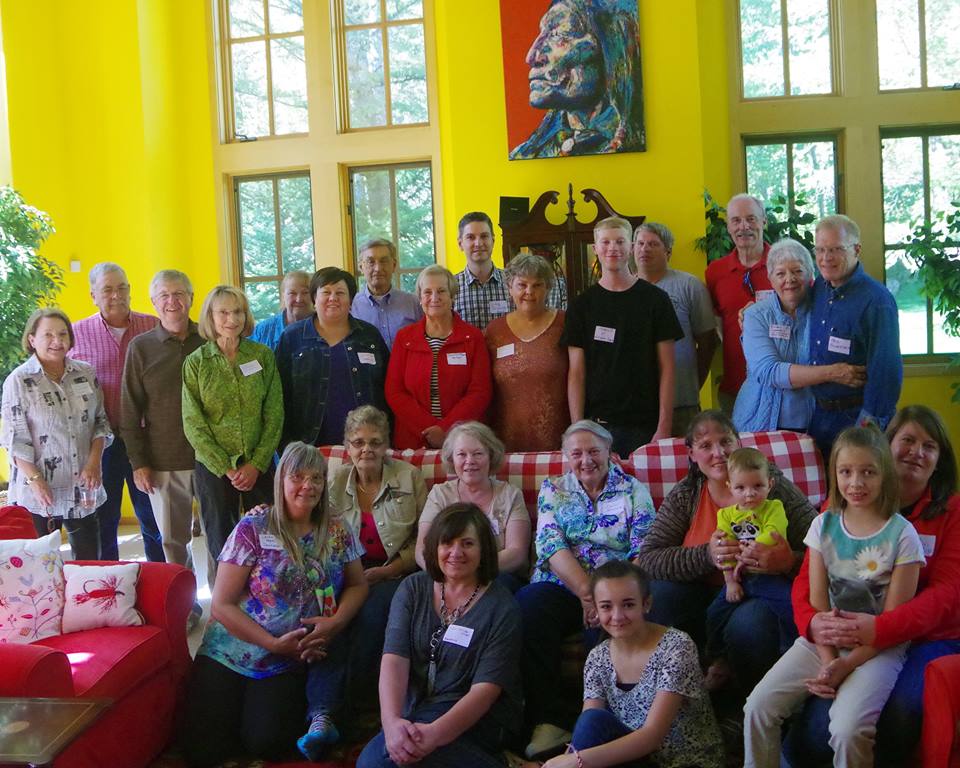
From the beginning, we wanted to have a reunion of the descendants who could come to Jackson. Susan, Mike, their sister, Kay Coates and Mike's son Gregg, generously hosted us at a beautiful and spacious house in Teton Village rented for this historic occasion, held on September 12, 2015. I'm happy to say that descendants of all of Henry and Emma's three children who lived to adulthood (Charles Henry, Lily McCain and William Downs) were able to come to the reunion. Some had never met one another. Some had never realized that they had so many cousins. All of us were thrilled to find and be with one another.

Those who came - Back row, L-R: Kay Coates, Brent Miller, Ed Wrasmann, Susan Wrasmann, Connalu Drinkwater, Mike Drinkwater, Gregg Drinkwater, Aaron Moulton, Bruce Burrows. Behind the couch: Carma Miller, Chris McCain Miller, Kristin Burgoyne, William Seeley,  Kathleen Schofield, Paul Schofield. On the couch: Dana Drinkwater Falkner, Kathi Reynolds Seeley, Carol McCain, Mary McCain Moulton holding Shaylieann Moulton, Robin Miller holding Annaleisha Moulton. In front of couch: Laura Koehnen (leaning on Dana), Jill Miller Hayes, Averi Hayes.

Wanting a lasting keepsake of the reunion, Susan put together a compilation of writing by herself, myself and Jon Freshour in a book titled Drinkwaters and McCains, telling the ancestry of this remarkable family that came together to honor and bury our long departed grandfather. The foreword is so applicable: "In every conceivable manner, the family is link to our past, bridge to our future" - Alex Haley.

If you would like a copy of the book, please let me know, and I will obtain one for you. Here is a link to the chapter about Henry and Emma's life, starting in England, and ending with his death: Henry Charles Drinkwater, A Restless Soul, by Kathleen Ellen Schofield: http://bit.ly/1KiMivF.


Henry Charles and Emma Hall Drinkwater

I believe that I can speak for the Drinkwater and McCain families by saying, may Henry finally rest in peace.

Henry and Emma reunited. We decided to allow Henry's stone to age and darken as has Emma's.
It shouldn't take long under the pine trees of Aspen Hill.

All photos courtesy of Kathleen Ellen Schofield
Postscript: our cousin, Jon Freshour contributed much to this whole process. Unfortunately, his health prevented him from traveling to Jackson. We missed you, Jon, and we appreciate all you have done.

Sunday, May 17, 2015

New York Marble Cemetery

The life of the dead is placed in the memory of the living.
Marcus Tullius Cicero


By 1831, New York City was about two hundred years old, and had experienced many disease epidemics. Believing that disease was spread by "miasmas," or noxious vapors of decaying organic matter, such as dead bodies, the city passed legislation outlawing earth graves. In response, Perkins Nichols built the New York Marble Cemetery (NYMC) for "gentlemen" and their families to be buried in. Marble vaults the size of small rooms were built ten feet underground in the excavated interior of the block bounded by Second Avenue, Second Street, Third Street and the Bowery. Protected by twelve feet high walls of Tuckahoe marble stones, no markers were on the ground. Rather, the vaults and their owners were identified by marble plaques in the North and South walls.

Goold Hoyt, 1769-1842

But I was not aware of any of this. While researching my ancestor Goold Hoyt, 1769-1842, I found that he and his wife, Sabina Sheaff Hoyt, 1790-1860, had memorials on the website, Find A Grave, and were interred in the NYMC. Thinking it to be a typical cemetery I requested photos of their gravestones. The photographer who responded told me about the underground vaults with the corresponding plaques. Now my interest was piqued, and I contacted the cemetery and received a reply from the extremely knowledgeable Anne W. Brown. 


To say that I was astonished when I read Anne's reply would be an understatement. I learned that I shared ownership of the vault, located in the now pricey East Village area, and purchased by Goold in 1830 for $250, with all of his other descendants, numbering over 100. Because I am his descendant, I have the right to be buried in the vault, as do all the others, ad infinitum. Here's what I wrote to Anne in an email after receiving her letter about the ownership: "I received your letter yesterday, and I must tell you that it left me pleasantly speechless for quite some time. I am still mulling over the impact of the thought that my 4th great-grandfather purchased a vault in 1830 that I now share the use and ownership of with other descendants ... I also did not realize that the cemetery is not supported by public funds or maintained by the city and I was amazed to read of the Luquer family's important leadership and guidance since 1915. What a remarkable story." (note - refers to the 2011 Newsletter, which be found on the NYMC website).

The garden
As mentioned, the cemetery receives no public funding, but is managed by a dedicated Board of Trustees. Since my first inquiry, and due to their concerted efforts, led by President Caroline S. DuBois, contributions have funded repairs to the two century old walls as well as the ongoing beautification efforts to the garden that allow it to be rented for special events, thus generating more income for repairs. Lots has been done, but more repairs are needed.


Ready for the 2015 Owners Meeting

I've been privileged to attend the owners' meeting with my cousin, Preston C. Adams, who grew up with me in Montana, but now lives in New York City, for three years in a row (2013, 2014 and 2015). My contribution to the repairs has been to become the Newsletter Editor as well as keeper of the database that contains the names of the vault owners and neighbors. 


Through our mutual interest in family history, I met some cousins for the first time this year. We share a special bond because we are descendants of the same people. What a treat to meet like minded folk who are related to me.
Cousins - L-R: Kathleen E Schofield, Lily Redmond, Preston C Adams, Joan Redmond
When you are in the area, I hope you'll stop by this beautiful and serene oasis in the bustling metropolis, and view it for yourself. The cemetery is open on the fourth Sunday of each month, May - September, and for Open House New York in October. The cemetery's website lists the dates on the "Map, Schedule & Tours" page. 

But don't just take my word for how special the NYMC is. Here are some other articles about it: Atlas Obscura, the New York Times, Greenwich Village Society for Historic Preservation (which gave the cemetery a village award in 2014). 

And, while you are in the neighborhood, you might as well go around the corner to Bonnie Slotnick Cookbooks, a bookstore that features out of print and antiquarian cookbooks, as well as really cool kitchen items. A great place to spend a few hours.

Saturday, June 28, 2014

What's In A Name?

"A good name is better than precious ointment; and the day of death, than the day of birth." Ecclesiastes 7:1

Last names, or surnames, are the basis for outlining one's family history. First, or given, names, especially when naming patterns were followed, can help us to fill in the contents of that outline.* However, even when this pattern was not followed, families often had a tendency to repeat the same given names. These names, especially when unusual, also help us to fill in the content of our outline.

Lily Agnes


Lily Agnes Drinkwater, 
1881-1964
One of my great grandmothers emigrated from Chester, England to the United States with her parents, Henry Charles and Emma Drinkwater, in the mid 1880's. She had an unusual and lyrical given name - Lily Agnes.

Lily's mother was Emma. Emma's mother was Hannah Alice Hall. But Hannah was never married to Emma's father. This, and the discrepancy in our records, have resulted in confusion in our family about his surname. On Emma's marriage certificate, her father is listed as Charles Edwards. But her obituary and death certificate state that she was Emma Baker Drinkwater. We didn't know whether he was Edwards or Baker. This confusion made it difficult to trace him, and so his family line ended with Emma.

Hints


One day a few months ago, while working on my Drinkwater family tree on the website ancestry dot com, I was presented with hints from another family tree, and I noticed the name Lily Agnes for two different people on this tree. Usually, I avoid hints from family trees because they may or may not be trustworthy. This time, my curiosity got the best of me.

Lily Agnes Harvey, 
1894-1922
I contacted the owner of the tree, telling her that the name Lily Agnes was so unusual that I felt that it was significant and must indicate a connection between us. She responded that Lily Agnes was the name of her grandmother, who was the daughter of Frederick John Harvey. And that she could provide me with information on the Harvey family. I eagerly accepted this offer because I knew that Hannah had married George Robert Harvey in 1862. I didn't know if they had any children, and I was curious to learn whether George's mother was named Lily, thinking that perhaps there was a naming pattern in the Harvey family, since I hadn't found one in Emma or Hannah's Hall family.


Lily Agnes Maguire,
1915-1982
As it turned out, the owner of the tree is Pat Evans, who lives in Wales. She and I are both descendants of Hannah Hall. And, her mother, Lily Agnes Maguire, was named after her grandmother. They were the two Lily's that prompted me to contact her.

From Pat I learned for the first time that Emma had an older brother, George Charles Edward Hall, also born before Hannah married George. And that they had seven half siblings, who were all the children of George and Hannah Harvey. That two of their sons, Emma's half brothers Frederick and William, named their oldest daughters Lily Agnes and Lily Agnes May. 


Hannah Alice Hall
1837-1916
Suddenly, I went from knowing of one Lily to learning that there were five Lily's in the Hall/Harvey family who were cousins** who shared an unusual name. I also learned that George's mother's name was Hannah as was his wife's, and not Lily. I still don't know why the family named so many of their daughters Lily, but, the name repetition I noticed led me to Pat, who sent me the information that allowed me to know who all of Hannah Harvey's children were and to fill in the content of my outline of the Hall/Harvey family tree. I went from thinking of Hannah as an unmarried "spinster" who gave birth to one child to knowing that she was the married mother of nine, who was widowed at the age of 45 while still having young children to care for.


Charles Edwards


Pat also shared enough information to confirm that George and Emma Hall's father was definitely named Charles Edwards. According to Emma's marriage certificate, his profession was baker. Pat sent me records showing that he was in a flour and baking business with his family whom I've been able to trace a couple of generations back. I also now know that he never married or had any other children.

When he died, in 1866, at age 32, he named his sister Catharine as his only heir, leaving her his estate of £100. It seems that he never acknowledged his two children and certainly didn't leave them money when he died. Family gossip says that he couldn't marry Hannah because he was connected with the Chester castle***. I now know that his only connection would have been to provide flour and baked goods to the castle, but I doubt that would give him a status that stopped the marriage. The informant for Emma's death certificate was her daughter Lily, who probably wrote her obituary also. We may never know why Lily said that Emma's maiden name was Baker, but I suspect that she saw no need to acknowledge her grandfather Charles, who didn't acknowledge his own children.

Postscript


Pat told me that her given name is Patricia, as was my mother's. They didn't know each other, yet they were cousins who shared the same name. And, when Pat's daughter recently gave birth to a daughter, she named her Lily. A meaningful, though perhaps unintended, repetition of given names.

Notes


*For instance, it was once common in the British Isles for oldest sons to be named after their father's father, second sons to be named after their mother's father, oldest daughters to be named after their mother's mother, second daughters to be named after their father's mother and so on.

**Cousins named Lily:

  1. Lily Agnes Drinkwater, 1881-1964, daughter of Emma. Ellen's great grandmother, 
  2. Lily Agnes May Harvey, 1887-1973, daughter of William Walter, Emma's half brother. Mother of Lily Evans Saltuer 
  3. Lily Agnes Harvey, 1894-1922, daughter of Frederick John, Emma's half brother. Pat's grandmother  (these three were first or half-first cousins)
  4. Lily Agnes Maguire, 1915-1982, Pat's mother
  5. Lily Rose Harvey, 1922-, granddaughter of Frederick John, Emma's half brother.
***Sometimes interpreted that he was of the royalty.


Monday, March 10, 2014

Why Know Our Family History?

I read an excerpt of this article in the September 2013 issue of Reader's Digest. It articulates the reason that our family history is so important, and how that knowledge can help our children and grandchildren cope with the challenges that they face in their lives. It reinforced that what I am doing has meaning, even if I don't post as often as I would like. 

Every February, Lynn Palermo hosts a Family History Writing Challenge packed full of tips on how to write about your family history in a way that will inspire anyone to read and enjoy it as much as you do. Even though February 2014 is past, you can sign up and learn from this year's instruction. 

Thursday, November 28, 2013

How My Dad's Family Found Me

Me, Lee M., Bruce, c 1954
Lee M. and Lee, c 1940
In 1958, when I was eight, and my brother Bruce was three, we lost our father Lee Marbell Burrows, the only child of Lee and Lois Hatch Burrows, in a tragic boating accident in Yellowstone National Park. His father, our grandfather Lee, had died ten years previously of a heart attack just three days shy of his 49th birthday, and six weeks before the marriage of his only child to our mother. We barely got to know our father, and never knew our grandfather.


Me, Bruce, Lois, 1962
Our grandmother Lois became our only connection to our dad's family, but she lived a day's drive away from us, and died just seven and a half years after our dad, in 1966. Once she was gone, my connection to my dad's family was slim. In 1990, one of our Burrows' relatives compiled a detailed chart of the family history and sent it to as many of the clan as she could. I appreciated receiving it, but after looking at it, put it away, too busy with raising my children to give it a lot of thought. It confirmed that while our family surname was Burrows, a result of a mistake made when my grandfather Lee enlisted in the Navy during WWI, my grandfather began his life as Lee Burrous, son of Marion Henry and Eliza Bushart Burrous, my great grandparents.

The Search Begins

From time to time, I googled Marion's name, finding bits and pieces of helpful information, which I dutifully filed away. I even made contact with a couple of cousins, one of whom sent me the same chart that I already had and a few stories about Marion's sons via e-mail. Unbeknownst to me, however, he was very ill, and passed away not long afterward. The other cousin was seeking, just as I was. Since neither of us had the information that the other sought, I once again felt that I was at an impasse.

Included in the few items about my dad's family that I inherited from my mom after her death in 2000, were my grandmother Lois' photos. None were marked unless my mom had done so from her memory. The only photo of the Burrous family was this poor, mimeographed copy of a copy of a family portrait taken in Genoa, Colorado in 1909. Just enough to make me curious.

A large, good-looking family. Thanks to my mom, I had names to go with the faces, but without any other information, they were all strangers to me.

Genealogy Classes Help Me Out

In 2011, after 10 years of being in possession of the family history files and photos that my mom had compiled and left behind after her death, I decided it was time for me to become serious about my family history. I enrolled in a 'community enrichment' genealogy class at my local community college. The class was about the latest methods in internet research, and was extremely helpful.

From the chart I had been sent, I knew that Eliza's father, William Henry Bushart, had enlisted in the Union Army in 1862 at the age of 37 or 38, and died in the Vicksburg campaign in 1863, leaving a widow, Susanna Hook Bushart, and six children, the youngest having been born just two weeks prior. 

Having learned about the website Find A Grave (findagrave.com) through my genealogy class, I searched for William, and found that he had a memorial already set up. I requested, and received management of it and added a photo of the Heroes of Illinois Memorial and a bio of my great-great grandfather. 

A Serendipitous Surprise

About that same time, one of my dad's cousins had learned about Find A Grave. Checking it out, he saw the work that I had done on William's memorial and emailed me. This was how we met, beginning a friendship and a correspondence that has continued on. As it turned out, he had visited William Henry's grave in person, leading to his interest in it and Find A Grave. 

The Missing Pieces

The original photo, sent to me by my cousin. Back row: L-R: James, Olive, Walter, Hobart, Hattie, Dewey, Claude, Lee (my grandfather). Front row: Sadie, Clarence, Theodore, Marion, Eliza, Homer, William
My cousin sent me photos and newspaper clippings among other helpful information, including this good copy of the family portrait. Finally, I began to feel that I knew my family as people, not just grainy faces on a poor copy of a copy.

The Burrous family and car, c 1909

Between what my cousin sent me, and the websites, Ancestry and Genealogy Bank, I've been able to piece together a fairly comprehensive life story for my great grandparents. I've learned that they married in Illinois in 1880 and had 14 children between the years of 1881 and 1906. That they farmed in Illinois, Minnesota and Colorado, and briefly toyed with idea of growing citrus in California, even purchasing a place there, but deciding to live in Colorado instead. There, Eliza died in 1929 at the age of 69 and Marion in 1937 at the age of 77. I've wondered what it must have been like for my great grandmother Eliza to be the mother of fourteen children, ten of them boys, and decided that she had to have had patience. According to Marion's obituary, he had a genial personality, cheery smile and friendly disposition and was a man who made friends and held them throughout his life. I can only hope that I inherited some of their fine qualities. 

One of the most precious photos that I received from my cousin, is this one of my great grandparents. When my daughter saw it, she exclaimed that the shape of my eyes is just like Eliza's, while I decided that I finally know where I got my nose!

Eliza Bushart and Marion Henry Burrous, c 1895

 Discovery

Our family has always enjoyed a good glass of  beer. I assumed it was because we were Westerners, but this photo leads me to believe that perhaps it's at least partly genetic! Taken at a family reunion in 1936 in Colorado, that's my dad Lee M, leaning on the keg. Great grandpa Marion is seated toward the left, holding a cane. All told, Marion and Eliza had 13 children who lived to adulthood, at least 39 grandchildren, and an untold number of great, great-great and great-great-great grandchildren. What a discovery for a girl with one sibling, and one first cousin. 


Sunday, May 19, 2013

Where Does the Time Go?

Kathleen and Preston
In my case, it's gone into planning and taking a trip to New York to hang out with my cousin Preston and to attend the Annual Owner's Meeting of the Marble Cemetery. It may sound a bit macabre, but if you consider that your ancestor's final resting place (in our case, Goold Hoyt, our 4th great grandfather) deserves respect, you may see it differently. One of the most surprising things I've learned since beginning to work on my family history is that cemeteries do not receive any funding from city, county or federal governments. Obviously, then, they rely on the descendants of the interred, and the public, for support. 


Newport

But that's not all that we did during my time as a New Yorker. We traveled to Newport, Rhode Island, where three generations of our family lived. The owners of their home on Kay Street, Pat and Mary Beth, kindly allowed us to tour this lovingly kept treasure, built in 1835. We felt honored to be sitting in the same rooms that our 4th great grandmother, Julia Montaudevert Lawrence, our great-great grandmother, Mary Lawrence Griffin Redmond, and our great-grandfather, William Preston Redmond, inhabited once upon a time. 

Entrance hallway with resident cats, Ricky and Lucy

New Jersey

Burlington

We also traveled to a few sites in New Jersey. We started out at the birthplace of our 4th great grandfather, Captain James Lawrence, in Burlington, where the Burlington County Historical Society's Education Director, Jeff Macechak, gave us a most informative tour. 

Captain James Lawrence display at the Burlington County Historical Society

Liberty Hall Museum

From there, we went to the Liberty Hall Museum at Kean University in Union. Primarily known as the home of New Jersey's first elected governor and signer of the Constitution, William Livingston, it was also where the second wife of our 3rd great grandfather, Christine Alexander William Kean Griffin, grew up. Bill Schroh, Jr, Director of Museum Operations, and his assistant, Kathy, gave us a personalized tour of this magnificent home and museum. 
One of the many beautiful rooms in the museum

South Orange

We ended our New Jersey day in South Orange, where the owners of a home purchased in 1850 by our 3rd great grandparents, William Sr and Sabina Hoyt Redmond, graciously gave us access so that we could see the original structure as well as the add-ons. According to the history of South Orange, this home, built in 1774, was part of the Squier Farm. We were happy to see it so well-loved and cared for. 

Renovated Squier Farm homestead. Original stone structure on bottom left.
Just down the street, we enjoyed a sunset dinner in the dining room of the Orange Lawn Tennis Club, established in 1880 in the brownstone building, "Hillside", that William Sr and Sabina built in 1848 as a home for their family of eleven children.


While we decried some of the architectural changes, I'm happy to know that Althea Gibson played her first important grass court tournament here. Other tennis greats listed as players include Arthur Ashe, Fred Perry, Rod Laver, Guillermo Vilas and John McEnroe.   

Orange Lawn Tennis Club, 2013

New York Historical Society

I spent a few hours one day at the New York Historical Society, taking photos of documents from the Eugene H. Poole Collection in the Patricia D. Klingenstein Library. Eugene Poole was a great-nephew of Captain James Lawrence who amassed a great deal of Lawrence memorabilia as a labor of love after the battle flag of Lawrence's ship, the U.S.S. Chesapeake, was given to England in 1908. Among this collection are documents and artifacts, some acquired after negotiation with my great grandfather in Wyoming. I was especially interested in James' letters to his family members, including the last letter he ever wrote, to his brother-in-law, James L. Montaudevert, asking him to look after his family. Unfortunately, James was "taken off" as he referred to in his letter.


Kearny Cottage Museum

On my last day as a New Yorker, I detoured to Perth Amboy, New Jersey, on the way to the airport. Here, I visited the Kearny Cottage Museum, once the home of Elizabeth Lawrence Kearny, aka Madame Scribblerus, and her husband, Michael Kearny. Elizabeth was James' half-sister, eldest of her father's family of eleven children. James was the youngest, and was raised by Elizabeth until he began a study of law. It is said that she passed on her love of poetry to him during this time. Michael and Elizabeth became the parents of eight sons, the youngest of whom, Commodore Lawrence Kearny was, like his uncle James, an officer in the U.S. Navy. He is famed for opening China to U.S. trade in the early 1840's. Curator Paul Wang generously opened the museum early, providing me with a very interesting tour. 


Serendipity

In the crowded airport gate waiting area, I sat next to Sam and Suchada Johnson and their adorable little daughter. Exchanging pleasantries, Sam offered the fact that he and his family live in Jackson, Wyoming, the town that was homesteaded by my great-great grandparents, John Porter and Margaret Sullivan Simpson. Sam invited me to their restaurant, Teton Thai, next time I'm in Jackson. Looking it up on the internet, I find that it has earned 4 stars on Yelp, and has lots of fantastic write-ups. Talk about the serendipity of travel!

Note to my readers: due to a technical glitch, I accidentally deleted my original post, forcing me to rewrite and re-post this synopsis of my trip to New York. It may differ slightly from the original, and I apologize for any inconvenience to you.